For years, finding a business online followed a familiar routine. A customer typed a few keywords into Google, scanned the search results, opened several websites and decided which company looked suitable.
That routine is changing.
People can now ask detailed questions such as, “Which accounting software is suitable for a small manufacturing company?” or “Find a digital marketing agency that provides SEO and paid advertising for B2B companies.”
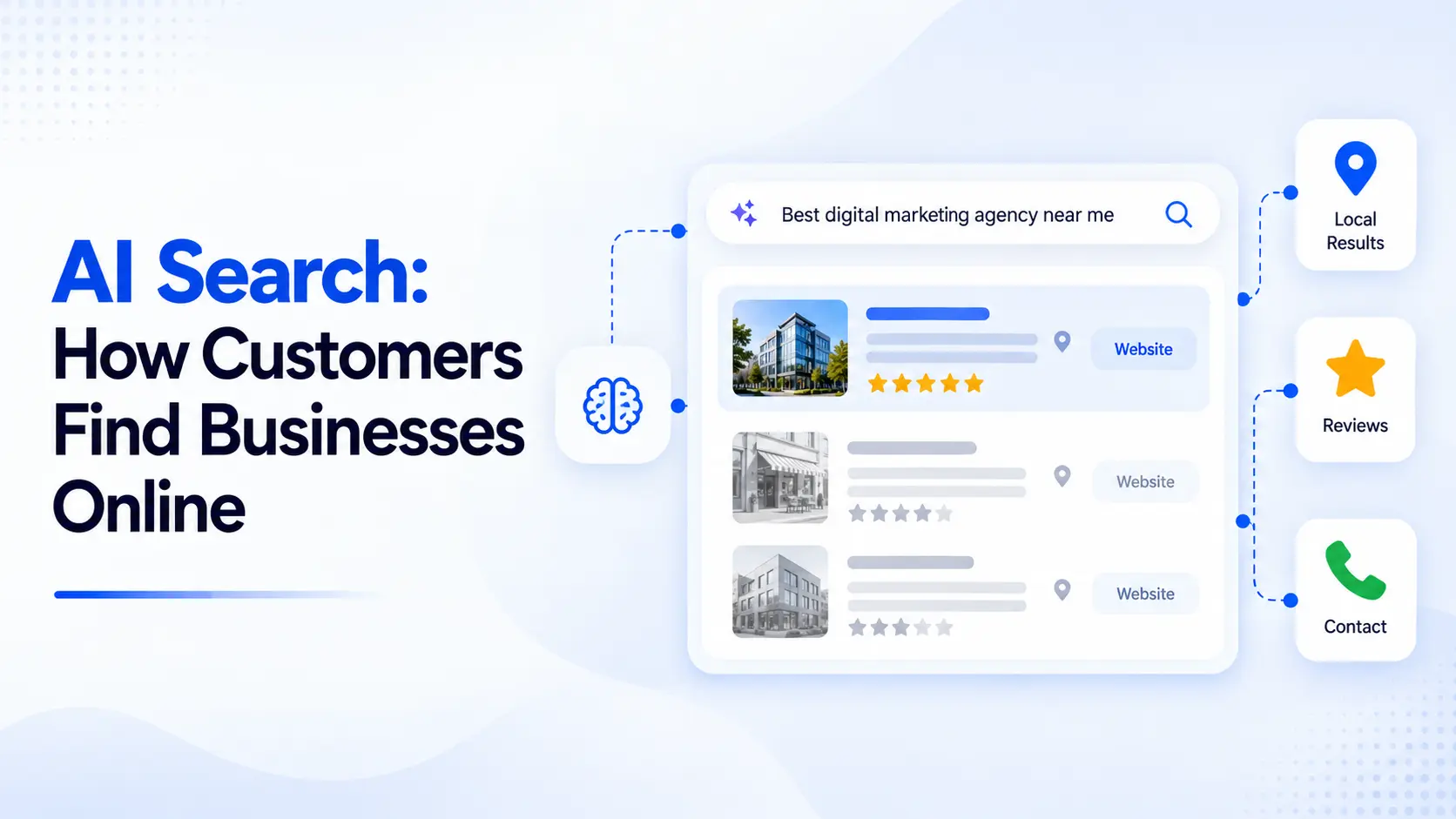
Instead of displaying only a list of links, an AI search engine can interpret the question, gather information from different sources and present an answer that helps the user narrow down the available options.
Google Search itself has moved further in this direction through AI Overviews and AI Mode. Other platforms, including ChatGPT, have also made conversational search familiar to millions of users.
For businesses, this changes an important part of digital marketing. Being present in traditional search results remains valuable, but companies also need to consider whether AI-powered search systems can understand their business, services, expertise and relevance to a customer’s question.
What Is AI Search?
AI search refers to search experiences that use artificial intelligence to understand questions and provide contextual answers instead of relying solely on a traditional list of search results.
Traditional searches often begin with short keywords:
“CRM software India”
“cloud service company”
“SEO agency near me”
With generative search, people can use more natural questions:
“What CRM is suitable for a 50-person sales team in India?”
“Which cloud services are useful for a growing ecommerce business?”
“What should I look for when choosing an SEO agency for a B2B company?”
The difference is important.
An AI-powered system tries to understand what the person actually wants to accomplish. It may consider several aspects of the question, look for relevant information and return a more direct response.
Google has reported that people using its newer AI-powered Search experiences are asking longer and more complex questions. This gives businesses an opportunity to create content around real customer problems rather than concentrating only on short keyword phrases.
Why Are Customers Using AI Search?
Search behaviour has always changed as technology improves. Mobile search changed when and where people looked for information. Voice search encouraged conversational queries. Generative AI is now changing how much detail users can include in a single search.
Suppose someone wants to hire a software development company.
A traditional search might look like:
“software development company India”
An AI-assisted query could be:
“I need a software development company in India that can modernize an old enterprise application and provide ongoing maintenance. What should I look for when comparing providers?”
That second query contains far more context.
Customers can explain their situation, ask follow-up questions and refine what they need without starting a completely new search each time.
This is one reason Google AI search and other conversational search tools matter for businesses. Search is becoming less dependent on finding the perfect keyword and more capable of understanding the complete question.
From Search Rankings to Business Discovery
Traditional SEO has largely focused on improving a website’s visibility for relevant searches. Rankings still matter, but AI-powered results introduce another consideration: whether information from a business is useful enough to contribute to an answer.
Imagine a user asks:
“What type of packaging label is best for a cosmetic bottle that may come into contact with water?”
A packaging company’s website might have useful information about pressure-sensitive labels, shrink sleeves, label materials and application conditions.
If those pages clearly explain the subject, a search system has useful information to work with.
A website containing only statements such as “We provide innovative packaging solutions for every business” provides much less substance.
This distinction is becoming important for AI search visibility.
Businesses need pages that clearly explain what they offer, who the service is designed for, where they operate, how their solutions work and what customers should consider before making a decision.
How AI Search Engines Understand a Business
An AI search engine does not evaluate a company from one sentence on its homepage. Search systems can use information available across webpages and other online sources to understand a subject.
For a business, useful signals may include service pages, product pages, location information, company details, educational articles, FAQs, reviews and other relevant references across the web.
Consistency matters here.
Consider a company that describes itself as an “AI development company” on its homepage but provides little information about its actual AI services.
Compare that with a company that has separate pages explaining AI agents, machine learning development, AI automation, implementation processes, use cases and industry applications.
The second website gives search systems much more context.
This is where good website architecture and detailed content support both traditional SEO and AI search optimization.
Is Traditional SEO Still Important?
Yes.
The growth of AI-generated search experiences does not mean traditional SEO has become irrelevant.
Google’s own guidance states that the fundamental SEO practices used for standard Search also apply to its AI features. Websites still need to be crawlable, technically accessible and useful to visitors.
Core SEO work therefore remains important:
- Create pages around genuine search intent.
- Use descriptive page titles and headings.
- Make important pages easy to crawl and index.
- Build sensible internal links.
- Provide useful original information.
- Keep business information accurate.
- Use structured data where appropriate.
- Maintain a fast, usable website.
The difference is that businesses should think beyond a single ranking position.
The broader question is whether the website provides enough useful information for both search engines and people to understand the company.
That is where AI SEO starts to overlap with conventional SEO.
AI SEO and Generative Engine Optimization
Terms such as AI SEO, Generative Engine Optimization, or GEO optimization, and Answer Engine Optimization are increasingly used to describe efforts to improve visibility within AI-generated answers.
These terms overlap considerably.
Traditional SEO asks questions such as:
“Can search engines crawl this page?”
“Does this page satisfy the search intent?”
“Is the website relevant for this topic?”
Generative Engine Optimization adds another question:
“Can an AI system easily understand and use this information when answering a related question?”
For most businesses, this does not require abandoning existing SEO work.
It requires improving the quality, clarity and depth of the information already being published.
How to Improve AI Search Visibility
Businesses interested in AI search optimization should start with their website rather than chasing shortcuts.
Answer the Questions Customers Actually Ask
A useful content strategy starts with customer conversations.
What do prospects ask before requesting a quotation? What concerns repeatedly appear during sales calls? What comparisons do customers make? What stops them from buying?
These questions can become service page sections, FAQs, guides and blog topics.
For example, instead of publishing another broad article titled “Benefits of Cloud Computing,” a cloud provider could answer more specific questions:
“How much does cloud migration cost for a mid-sized business?”
“What should a company move to the cloud first?”
“What are the risks of migrating a legacy application?”
Specific questions create useful content for traditional search and conversational search.
Create Clear Service Pages
Every important service should have enough information to stand on its own.
A strong service page should explain what the service is, who needs it, common use cases, the process involved, relevant considerations and frequently asked questions.
Avoid filling these pages with marketing slogans.
If someone searches for your service, the page should help them understand whether it fits their requirements.
Demonstrate First-Hand Experience
Generic information is easy to reproduce.
Actual business experience is harder to replace.
Where appropriate, companies can publish case studies, implementation examples, original research, expert commentary and practical lessons from completed projects.
A software company, for instance, can explain how it approached a legacy modernization project without revealing confidential client information. A marketing agency can discuss what changed after restructuring a campaign. A manufacturer can explain why one material performs differently from another in a particular application.
This type of content gives readers information they cannot get from a generic definition.
Keep Business Information Consistent
Customers may discover a company through its website, business listing, industry directory, review platform or another third-party source.
Major inconsistencies between these sources can create confusion.
Business name, services, contact details, locations and important company information should therefore remain accurate wherever the company has an active presence.
For businesses dependent on local customers, this also supports local search visibility.
Use Structured Content Where It Helps
Good content does not need to sound robotic to be easy to understand.
Clear headings, descriptive subheadings, concise answers and logical page structure make information easier for visitors to scan.
Relevant structured data can also help search engines understand certain types of website information.
The goal is clarity rather than writing content specifically for a machine.
What ChatGPT Search Means for Businesses
ChatGPT search has added another route through which people can research products, services and companies.
A customer researching a complicated purchase may ask several questions in the same conversation. They can compare approaches, learn terminology, narrow their requirements and eventually look for companies that meet those requirements.
That changes the customer journey.
A potential buyer may already understand the available options before reaching a company’s website. As a result, weak introductory content may do little to influence the decision.
Businesses should consider content for different stages of research.
A potential customer may want to know what a service does at the beginning of the process. Later, the same person may want pricing information, comparisons, implementation requirements or evidence that a provider has relevant experience.
Covering these questions gives a business a stronger presence throughout the research process.
What Does This Mean for Business Websites?
The biggest mistake would be treating AI search visibility as a separate marketing trick.
A thin website will not become useful simply because a few new keywords such as “GEO” or “AI search” are added to it.
Start with the information customers need.
Review important service pages. Look for unanswered questions. Check whether claims are supported by useful detail. Make expertise visible. Remove outdated information. Strengthen internal links between related topics.
Then review how those pages perform across traditional search and newer AI-powered search experiences.
The businesses most prepared for this shift will be those that make their expertise easy to find and easy to understand.
The Future of Search Engines and Business Discovery
The future of search engines is unlikely to involve the complete disappearance of websites or conventional search results. Current AI search products still connect users with web content, and Google continues to emphasize links and web discovery within its AI-powered experiences.
What is changing is the route people take to reach that content.
Some users will still search with two or three keywords. Others will describe their entire problem in a paragraph. Some will ask an AI assistant for an explanation before visiting any company website.
Businesses therefore need content that works across these different behaviours.
Traditional SEO provides the technical and content foundation. AI search optimization extends that thinking to conversational discovery, AI-generated answers and more complex search journeys.
For businesses, the practical priority remains straightforward: publish accurate information that answers real customer questions and clearly demonstrates what the company knows and does.
Frequently Asked Questions
What is AI search?
AI search uses artificial intelligence to interpret a user’s question and provide a contextual response. Depending on the platform, the answer may include summaries, recommendations, web links or information gathered from multiple sources.
How is AI search different from traditional Google Search?
Traditional search commonly presents a ranked set of webpages in response to a query. AI-powered search can generate a direct answer and allow users to continue with follow-up questions. Google Search now combines conventional search features with experiences such as AI Overviews and AI Mode.
What is AI search optimization?
AI search optimization refers to improving online content so that it is clear, useful and easy for AI-powered search systems to understand. It overlaps heavily with established SEO practices such as technical accessibility, useful content, topical relevance and clear website structure.
What is Generative Engine Optimization?
Generative Engine Optimization, commonly called GEO, describes efforts to improve a brand or website’s visibility in responses produced by generative search systems. GEO optimization usually focuses on clear information, topical authority, credible sources and content that directly answers relevant questions.
What is the difference between SEO and GEO?
SEO traditionally focuses on organic visibility in search engine results. GEO focuses on visibility within generative answers. The two disciplines share many fundamentals, so businesses generally benefit from treating GEO as an extension of a strong SEO and content strategy rather than a replacement for SEO.
Can AI search help customers discover local businesses?
Yes. AI-powered search can help users research businesses based on location, services, reviews and other available information. Local businesses should keep their website and business information accurate and provide clear information about their services and service areas.
Does ChatGPT search replace Google?
They are different search and discovery experiences, and users may use both during the same buying journey. Businesses should focus on making their information accessible and useful across the places where potential customers conduct research.
How can a business improve its AI search visibility?
Start by improving important service and product pages, answering real customer questions, publishing useful first-hand information, maintaining accurate business details and following sound technical SEO practices. AI visibility should grow from a strong information base rather than from repeating AI-related keywords.
Is AI SEO different from regular SEO?
There is substantial overlap. AI SEO pays additional attention to how content may surface in AI-generated responses, while conventional SEO covers organic search more broadly. Technical SEO, useful content, authority, clear structure and relevance remain important to both.
Will AI search reduce website traffic?
The effect will vary by query and website. Some questions can be answered directly within a search interface, while other searches lead users to websites for deeper research, comparisons or transactions. Businesses should measure their own organic traffic, conversions and search visibility rather than assuming that every AI-generated result has the same impact.