If you have been running Facebook or Instagram ads for a while, you may have noticed something unusual. Campaigns that previously delivered consistent results are becoming harder to predict. Some broad audiences perform better than carefully selected interests, while ads with similar targeting produce very different results.
Part of this shift relates to changes in Meta’s advertising technology.
On October 28, 2026, Meta published details about the next generation of Andromeda, its AI-powered ad retrieval system. The announcement explains how Meta is improving the process of selecting relevant advertisements from an enormous pool of eligible ads.
For advertisers, this raises practical questions. Does audience targeting still matter? Should businesses create more advertisements? Are traditional campaign structures becoming less effective?
This guide explains the Meta Andromeda 2.0 update, what has actually changed, and how businesses can adjust their Meta Ads strategy without wasting advertising budgets.
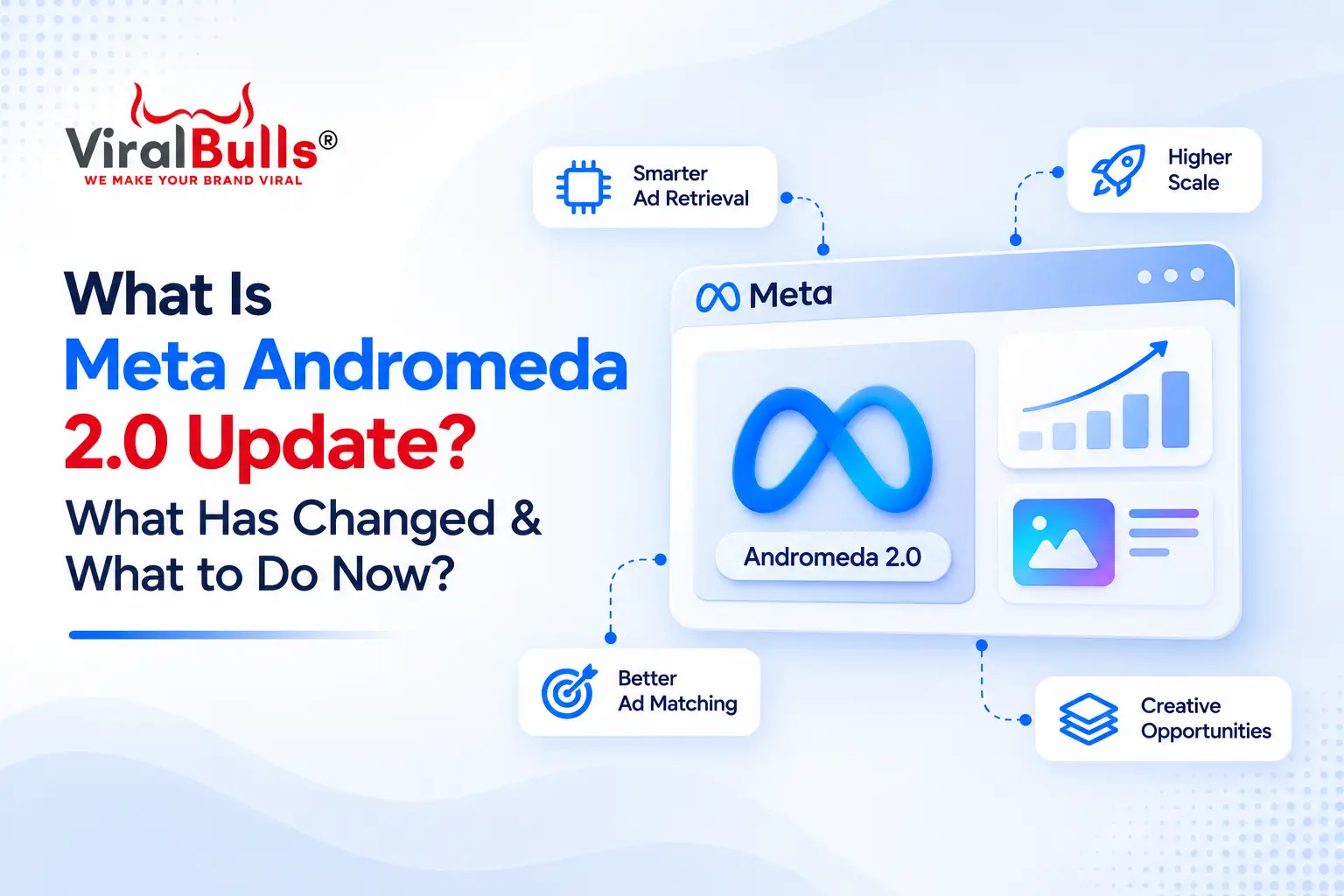
What Is Meta Andromeda 2.0 Update?
The Meta Andromeda 2.0 update refers to the latest improvements to Meta’s AI-powered advertising retrieval technology.
Andromeda is responsible for identifying which advertisements are suitable candidates for a particular user before Meta’s ranking systems make the final delivery decisions.
The original Andromeda system was introduced publicly in December 2024. It improved Meta’s ability to evaluate large numbers of advertisements and identify relevant matches between users and advertisers.
The next-generation system, described in October 2026, significantly expands that capability.
According to Meta’s engineering announcement, the updated architecture can evaluate more than one billion eligible advertisements per second, approximately 100 times the throughput of its 2024 system.
It also brings more sophisticated prediction capabilities into the initial retrieval stage.
Importantly, Andromeda is an underlying advertising technology. Advertisers do not need to activate a separate Andromeda 2.0 setting inside Ads Manager.
How Does Meta Andromeda Work?
To understand the latest Meta Ads update, it helps to understand how Meta selects advertisements.
Whenever someone opens Facebook or Instagram, Meta has to decide which advertisements are most relevant to that person.
This happens through several stages.
Stage 1: Ad Retrieval
Meta begins with a large pool of eligible advertisements.
Andromeda evaluates potential candidates using machine learning and selects a smaller group that appears relevant to the user.
This stage needs to happen extremely quickly because millions of people are interacting with Meta’s platforms simultaneously.
Stage 2: Ad Ranking
The shortlisted advertisements move to more sophisticated ranking systems.
These systems evaluate factors such as predicted user actions, advertiser objectives, ad quality, and other relevant signals.
Stage 3: Ad Delivery
Meta’s advertising system determines which eligible advertisement wins the opportunity to appear.
The final decision also depends on auction-related factors.
The distinction matters because Andromeda does not independently control every aspect of ad performance. It improves the retrieval stage within a larger advertising system.
What Has Changed in Meta Andromeda 2.0?
The October 2026 announcement highlights several technical improvements.
1. Faster Evaluation of Advertisements
The updated system can evaluate more than one billion eligible advertisements per second.
This represents a substantial increase in processing capacity compared with the original Andromeda architecture.
For advertisers, the practical implication is that Meta can consider a much larger selection of potential advertisements without exceeding its strict delivery-time requirements.
However, this does not mean every advertiser will automatically experience lower advertising costs.
2. More Sophisticated Ad Matching
Earlier retrieval systems were limited in how much predictive modelling they could perform before selecting candidates.
The new architecture brings retrieval-stage predictions closer to the sophistication traditionally associated with later ranking systems.
This allows Meta to make more informed decisions when shortlisting advertisements.
A business offering premium skincare, for example, may benefit when Meta can better identify people likely to respond to its specific products and advertising messages.
3. Greater Capacity for Creative Variations
Meta’s advertising ecosystem contains an increasing number of creative variations, partly because of automated creative tools.
Andromeda’s updated architecture is designed to process this growing volume efficiently.
This creates opportunities for advertisers to test different messages and formats.
However, uploading dozens of nearly identical advertisements is not a guaranteed strategy for improving performance.
Creative quality and relevance remain important.
4. Improvements to Advertising Efficiency
Meta reports that Andromeda has contributed to a 2.4% increase in Facebook conversions since 2025.
This is a system-level result reported by Meta, not a promised improvement for every advertising account.
Individual results will continue to depend on the product, audience, campaign objective, conversion data, and creative execution.
Meta Andromeda 2.0 vs. the Previous System
| Area | Original Andromeda | Next-Generation Andromeda |
|---|---|---|
| Public announcement | December 2024 | October 2026 |
| Main function | Personalized ad retrieval | More advanced personalized ad retrieval |
| Model capability | Major increase over earlier retrieval systems | Predictions closer to ranking-level sophistication |
| Processing capacity | Tens of millions of ads per second per GPU | More than one billion ads per second |
| Creative handling | Supports large creative pools | Greater capacity to evaluate expanding creative pools |
| Advertiser impact | Improved ad matching | Potentially more accurate matching across more candidates |
These are infrastructure improvements. Meta has not announced that advertisers must rebuild every campaign or abandon all existing targeting options.
How the Latest Meta Ads Update Affects Advertisers
Although the changes happen behind the scenes, they reinforce several important considerations for campaign management.
Creative Strategy Deserves More Attention
Meta’s system evaluates relationships between users and advertisements.
The advertisement itself provides useful information about the product, its positioning, and the audience that may respond.
For example, consider a jewellery business promoting diamond rings.
One advertisement may focus on bridal jewellery, another on everyday diamond rings, and another on anniversary gifting.
Each communicates a different purchase motivation.
Testing these distinct approaches can provide more useful information than repeatedly changing the headline on the same product image.
Broad Targeting Is Worth Testing
Meta’s automated advertising systems can identify potential customers beyond narrowly defined interest groups.
This makes broader audience strategies worth testing, particularly when advertisers have reliable conversion signals.
However, broad targeting should not automatically replace every restricted audience.
Businesses serving specific geographical areas, age groups, or customer categories may still require appropriate targeting controls.
The right approach depends on campaign performance and business requirements.
Conversion Data Remains Important
Better ad retrieval does not eliminate the need for accurate measurement.
Meta still needs useful signals to understand which advertising interactions produce valuable outcomes.
Businesses should review their Meta Pixel, Conversions API, event tracking, and lead-quality feedback.
For lead generation campaigns, submitting a form does not necessarily mean someone is a qualified prospect.
Where appropriate, sending reliable downstream conversion information can help advertisers evaluate performance against actual business outcomes.
What Should Advertisers Do After the Meta Andromeda 2.0 Update?
The most useful response is to improve campaign inputs and measurement rather than make changes based on unverified algorithm claims.
1. Audit Your Existing Campaigns
Start by examining the last 30 to 60 days of campaign performance.
Review:
- Cost per qualified lead or purchase
- Conversion rate
- Cost per result
- Return on ad spend, where applicable
- Creative-level performance
- Audience performance
- Conversion tracking accuracy
Look for patterns before deciding whether campaign restructuring is necessary.
2. Test Different Creative Concepts
Creative diversification means testing meaningfully different advertising approaches.
For a salon franchise campaign, useful concepts might include:
- Franchise investment requirements
- Training and operational support
- Salon interiors and customer experience
- Franchise owner responsibilities
- Brand recognition and business model
Each concept answers a different potential investor question.
This is more useful than creating ten advertisements with the same photograph and slightly different headlines.
3. Simplify Campaign Structure Where Appropriate
Some advertising accounts contain numerous ad sets targeting overlapping audiences.
This can divide budgets and make performance analysis more difficult.
Consider whether similar ad sets can be consolidated without losing necessary audience controls or testing clarity.
Campaign consolidation should be based on available budget, conversion volume, and performance evidence.
4. Improve Lead Quality Measurement
For businesses running Meta lead generation campaigns, lead quality should receive as much attention as lead quantity.
Suppose a franchise advertisement generates 100 enquiries, but only 10 prospects meet the minimum investment requirement.
A second advertisement produces 50 enquiries, with 20 qualified prospects.
The second campaign may provide better business value despite generating fewer leads.
Track qualified leads, appointments, and actual sales outcomes wherever possible.
5. Use Advantage+ Features Strategically
Meta’s Advantage+ tools automate elements of targeting, placements, creative optimization, and campaign management.
These features may help advertisers use Meta’s prediction systems more effectively.
However, automation does not replace strategic decisions.
Advertisers still need to select suitable campaign objectives, create relevant advertisements, establish budgets, and evaluate results.
6. Avoid Excessive Campaign Editing
Changing budgets, audiences, and creatives too frequently can make campaign performance difficult to interpret.
Allow sufficient time for meaningful data collection before making decisions.
There is no universal testing period that works for every campaign. The appropriate duration depends on spending levels and conversion volume.
How to Build a Better Meta Ads Creative Strategy
A practical creative testing framework should begin with customer motivations.
Consider an ecommerce brand selling premium watches.
Instead of producing multiple versions of one advertisement, the brand could test three distinct concepts.
Concept A: Product Quality
Show the watch’s materials, finishing, and construction details.
Concept B: Lifestyle
Demonstrate how the watch fits different occasions and personal styles.
Concept C: Gifting
Position the product as a gift for anniversaries, birthdays, or professional milestones.
These concepts communicate different reasons to purchase.
The advertiser can then compare results and develop additional variations around the strongest ideas.
Creative diversification does not require producing expensive videos for every concept. Product photography, demonstrations, customer testimonials, and straightforward videos can all be tested.
The objective is to learn which messages attract relevant customers.
Common Mistakes to Avoid After the Update
Believing That Targeting No Longer Matters
The claim that creative has completely replaced audience targeting oversimplifies how Meta Ads works.
Audience settings, eligibility requirements, location controls, and campaign objectives still influence delivery.
Uploading Too Many Similar Ads
More advertisements do not automatically produce better results.
A small collection of genuinely different creatives may provide more useful testing opportunities than a large collection of minor variations.
Rebuilding Every Campaign Immediately
The latest Meta Ads update does not mean every existing campaign structure has become ineffective.
If a campaign consistently delivers profitable results, there may be no reason to make substantial changes.
Ignoring Conversion Tracking
Creative improvements cannot compensate for inaccurate business reporting.
Advertisers need to know whether campaigns generate qualified customers, not simply clicks and impressions.
Expecting Guaranteed Performance Improvements
Meta’s reported system-level improvements should not be interpreted as guaranteed account-level results.
Advertising performance continues to depend on competition, product demand, customer experience, and campaign execution.
What Does Meta Andromeda 2.0 Mean for the Future of Meta Advertising?
Meta is investing in advertising systems that can evaluate larger candidate pools and make increasingly sophisticated predictions.
This direction supports greater automation, more personalized ad matching, and the ability to handle expanding creative inventories.
For advertisers, the opportunity is to provide better inputs.
Relevant creative concepts, accurate conversion signals, clear business objectives, and disciplined testing will remain important.
Manual targeting and campaign management still have a role, but advertisers should assess where automation can improve efficiency.
The strongest strategy is one that combines Meta’s automated systems with a clear understanding of customer behaviour and commercial performance.
Conclusion
The Meta Andromeda 2.0 update represents a substantial improvement in Meta’s advertising retrieval technology.
The next-generation architecture can evaluate far more advertisements while using more sophisticated predictions to identify relevant candidates.
For businesses, this reinforces the value of creative testing, accurate conversion tracking, and thoughtful campaign structure.
There is no need to replace every existing advertising strategy simply because Meta has updated its underlying technology.
Start with your campaign data, identify opportunities for improvement, and test changes against meaningful business outcomes.
Frequently Asked Questions
1. What is Meta Andromeda 2.0 update?
The Meta Andromeda 2.0 update is an industry term for improvements to Meta’s AI-powered ad retrieval system. Meta announced its next-generation Andromeda architecture on October 28, 2026.
2. When was the latest Meta Andromeda update announced?
Meta published its latest technical announcement on October 28, 2026. The original Andromeda system was publicly introduced in December 2024.
3. Does Meta Andromeda 2.0 affect Facebook and Instagram ads?
Andromeda supports Meta’s advertising recommendation infrastructure. The October 2026 announcement specifically reports conversion improvements on Facebook, while Andromeda technology has been deployed across Meta’s advertising ecosystem.
4. Does Meta Andromeda 2.0 remove interest targeting?
No. Meta has not announced that Andromeda 2.0 removes all interest targeting. Advertisers can continue using available targeting controls while testing automated audience strategies where appropriate.
5. Should advertisers use broad targeting after the update?
Broad targeting is worth testing when campaigns have appropriate objectives and reliable conversion data. However, it is not guaranteed to outperform every interest-based or restricted audience.
6. How many creatives should advertisers run?
There is no officially confirmed universal number required by Andromeda 2.0. Advertisers should select a manageable number of distinct creative concepts based on budget, conversion volume, and testing objectives.
7. Does the Meta Andromeda update increase advertising costs?
Meta has not established that the update automatically increases advertising costs. CPM, CPC, and cost per conversion can change because of competition, seasonality, creative performance, and other factors.
8. Is Meta Andromeda 2.0 the same as Advantage+?
No. Andromeda is an underlying ad retrieval system. Advantage+ refers to Meta’s automated advertising features and campaign tools.
9. How can businesses improve Meta Ads performance after the update?
Businesses should review campaign performance, test distinct creative concepts, improve conversion tracking, evaluate qualified leads, and use automation where it supports their objectives.
10. Do advertisers need to activate Meta Andromeda 2.0?
No. Andromeda operates within Meta’s advertising infrastructure. It is not a separate feature that advertisers need to enable manually.
Also Read: Guerrilla Marketing: What It Is, How It Works, Pros and Cons