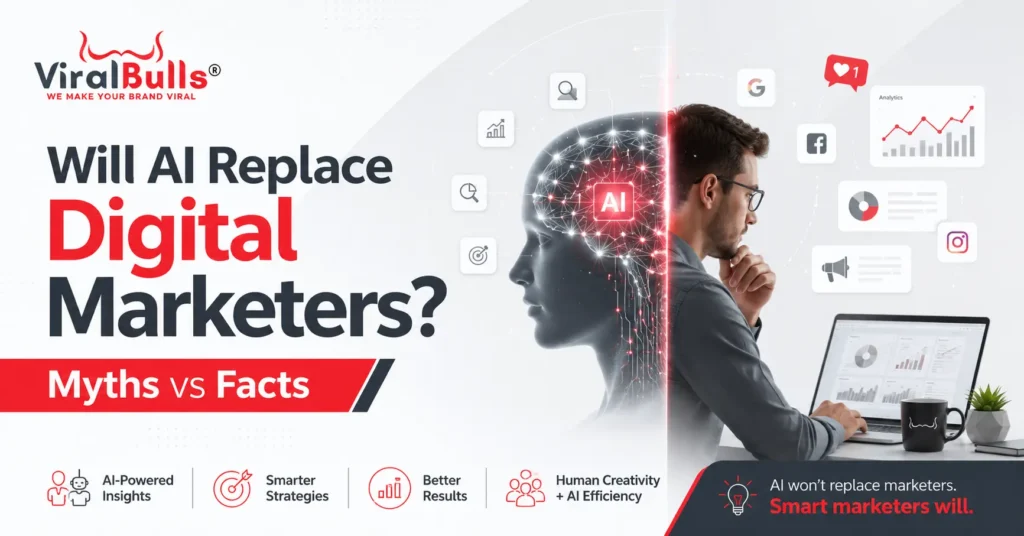
TL;DR: Will AI Replace Digital Marketers?
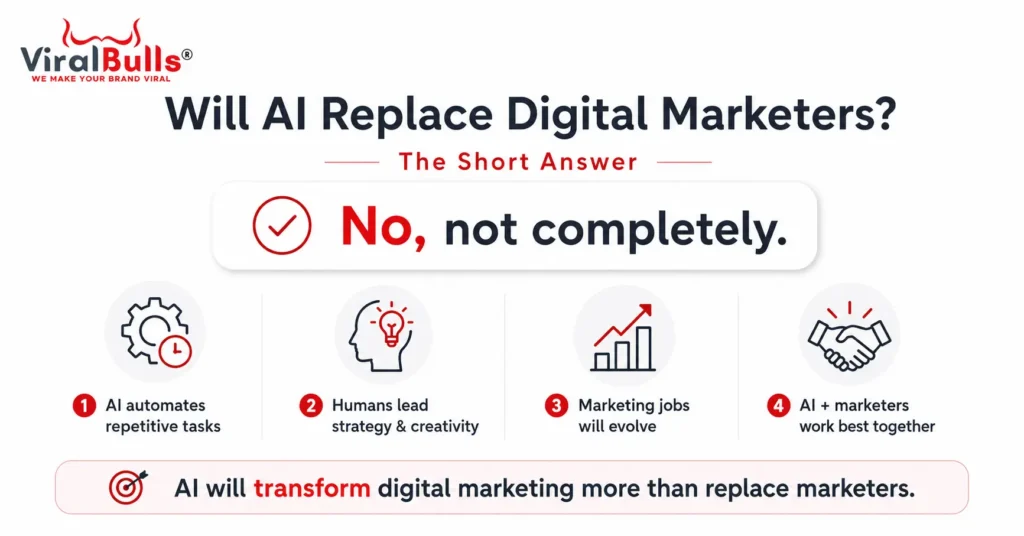
No, AI is unlikely to replace digital marketers completely. It will automate repetitive work such as basic reporting, content variations, audience segmentation, bid adjustments, and workflow administration. Successful marketing still depends on human strategy, customer empathy, creative direction, commercial judgment, ethical oversight, and accountability.
The practical answer to “Will AI Replace Digital Marketers?” is that AI will transform the profession more than eliminate it. Marketers who use AI responsibly will gain an advantage, while professionals who only perform repeatable execution tasks face greater disruption.
Will AI Replace Digital Marketers? Not entirely. AI will automate a growing share of execution, analysis, personalization, and content production, but it cannot independently replace human strategy, empathy, cultural understanding, leadership, or responsibility. Digital marketers will not disappear. Their roles will become more analytical, creative, technical, and commercially accountable.
Generative AI can create copy, optimize bids, score leads, trigger emails, and summarize performance. Yet marketing is not simply producing assets. It is understanding customers, shaping demand, differentiating a brand, allocating resources, and generating profitable growth. AI can support decisions, but it cannot own them.
The Direct Answer: Will AI Replace Digital Marketers?
AI will replace some marketing tasks and may reduce demand for narrowly defined, execution-only positions. It is less likely to replace versatile marketers who understand customers, strategy, data, creative direction, technology, and revenue.
McKinsey reported that 78% of surveyed organizations used AI in at least one business function in 2024, while 71% used generative AI. Marketing and sales were among the most common areas for generative AI adoption. HubSpot reported in 2025 that 66% of marketers globally were already using AI in their roles.
These figures show that AI in digital marketing is becoming standard infrastructure. Employers may need fewer hours for routine production, but more people who can define problems, validate outputs, protect data, govern tools, and turn insights into action.
Can AI replace marketers? It can replace parts of a job. It cannot reliably own the complete business outcome.
Why the Fear Is Growing
Google says advertisers activating AI Max for Search typically saw 14% more conversions or conversion value at a similar CPA or ROAS. Meta’s Advantage+ suite uses AI and automation to optimize audiences, placements, delivery, and creative variations.
These systems reduce manual work, but they do not remove the need for offers, tracking, landing-page quality, experimentation, or budget governance.
The World Economic Forum found that 40% of employers expected to reduce the workforce where AI could automate tasks. The same research projected that AI and information-processing technologies could create 11 million jobs while displacing 9 million.
The likely outcome is role redesign, not the disappearance of marketing.
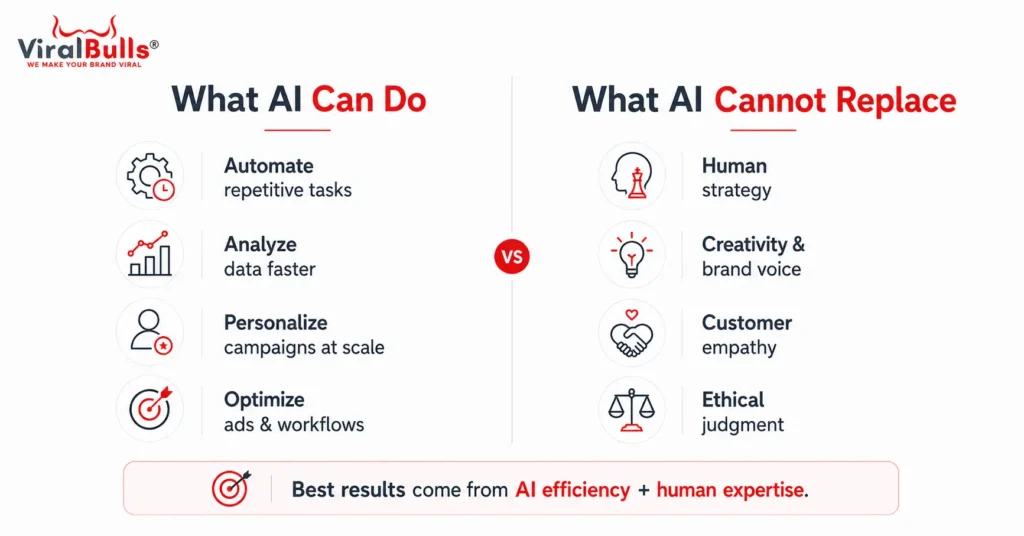
What AI Can Do in Digital Marketing
The benefits of AI in digital marketing are strongest when work involves large datasets, repeatable processes, rapid variation, or rule-based decisions.
Content Research and Drafting
AI can summarize approved sources, organize topics, suggest outlines, repurpose material, and create variations. Human review remains necessary for accuracy, originality, tone, claims, and search intent.
Paid Media Optimization
AI can support bidding, audience expansion, placements, creative combinations, and forecasting. The marketer still sets objectives, acquisition-cost limits, measurement, creative direction, and tests.
Segmentation and Personalization
Artificial intelligence in marketing can segment users and personalize recommendations, email timing, website experiences, and retention messages. Results still depend on consent, clean data, frequency, and sound rules.
Analytics and Automation
AI can summarize dashboards, detect anomalies, classify feedback, score leads, route contacts, and trigger nurture sequences. HubSpot’s Breeze connects AI assistants and agents with CRM data.
AI still cannot confirm tracking accuracy, causality, or long-term brand impact. Automation improves good systems and accelerates bad ones.
What AI Cannot Replace
The key difference in AI vs human marketers is capability versus responsibility. AI can generate an option. A human must decide whether it is true, appropriate, differentiated, lawful, and commercially sensible.
Strategic Judgment
AI can recommend strategies from patterns and supplied context. It does not independently understand a company’s cash flow, constraints, risk tolerance, or long-term ambition. Strategy requires trade-offs and accountability.
Customer Empathy
Models can analyze sentiment, but they do not experience frustration, aspiration, trust, or loyalty. Human marketers learn from interviews, support tickets, communities, and sales calls.
Original Positioning and Creative Direction
Without strong direction, AI tends to produce familiar language. Brands win by creating meaningful difference. Positioning requires insight, taste, courage, and consistency.
Cultural, Ethical, and Legal Judgment
AI can miss cultural nuance or reinforce bias. It also cannot accept responsibility for misleading claims, privacy violations, copyright conflicts, or reputational harm.
Leadership
Marketing leaders secure budgets, align teams, resolve disagreements, coach employees, defend priorities, and communicate uncertainty. These remain human tasks.
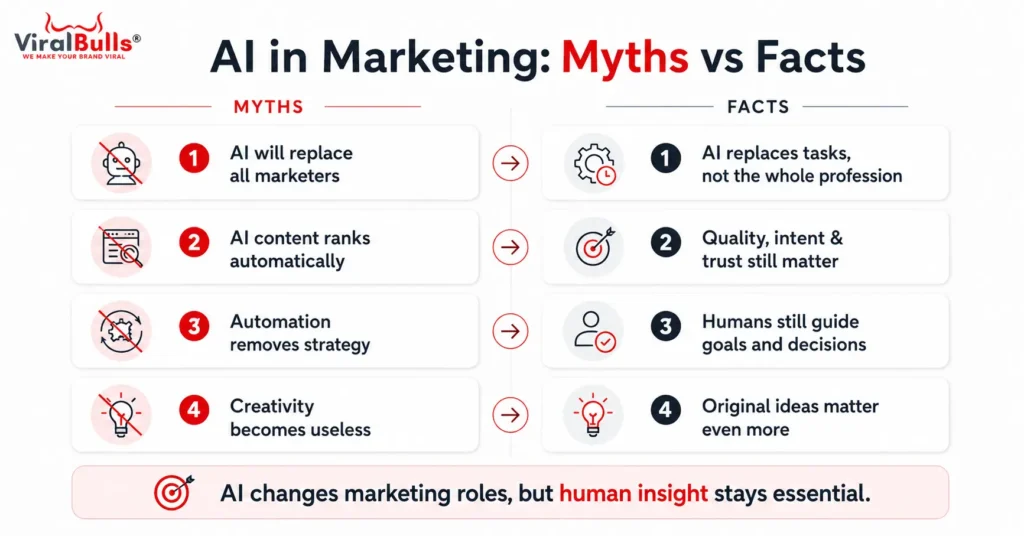
Myths vs Facts: Will AI Replace Digital Marketers?
| Myth | Fact |
|---|---|
| AI will eliminate every digital marketing job. | AI is more likely to automate task bundles and reshape roles than remove the profession. |
| AI content can be published without editing. | Outputs need fact-checking, brand editing, originality review, and expert approval. |
| Automated ad platforms no longer need marketers. | They still require strategy, measurement, creative testing, and commercial oversight. |
| AI always makes unbiased decisions. | AI can reproduce bias from data, objectives, models, or workflow design. |
| More AI content automatically improves SEO. | Search performance depends on usefulness, evidence, intent satisfaction, authority, and technical quality. |
| AI understands customers better than people. | AI finds patterns at scale; humans provide empathy and context. |
| Creativity will become irrelevant. | As average content becomes easier to make, distinctive ideas become more valuable. |
| Agencies will become unnecessary. | Production-only agencies face pressure, while strategic and integrated agencies can become more valuable. |
Real-World Examples of AI in Marketing
Google uses AI across Search ads, Performance Max, bidding, query matching, and asset generation. AI Max can expand query reach and adapt assets. Marketers remain responsible for economics, quality, messaging, and measurement.
Meta
Meta Advantage+ optimizes audiences, placements, delivery, and creative variations. It reduces manual work, but weak creative, tracking, or offers still restrict performance.
HubSpot
HubSpot Breeze embeds AI into CRM workflows, content assistance, customer intelligence, and agents. This extends the role of AI in marketing beyond copywriting.
OpenAI
OpenAI highlights campaign planning, drafting, performance analysis, message iteration, and asset adaptation, while recommending human judgment for nuance, accuracy, and final approval.
Which Marketing Roles Are Most Exposed?
The answer to “Will AI Replace Digital Marketers?” depends on how a role creates value.
More exposed roles rely heavily on:
- Repetitive production
- Manual report compilation
- Template-based copy
- Basic campaign setup
- Data transfer between tools
- High-volume resizing or reformatting
- Rule-based communication
More resilient roles combine:
- Customer and market research
- Brand strategy and creative direction
- Performance interpretation
- Revenue and unit-economics knowledge
- Experiment design
- Marketing technology architecture
- Governance, leadership, and industry expertise
Entry-level work will change, and beginners may be expected to demonstrate judgment earlier. Businesses should still preserve learning opportunities because senior expertise develops through practice.
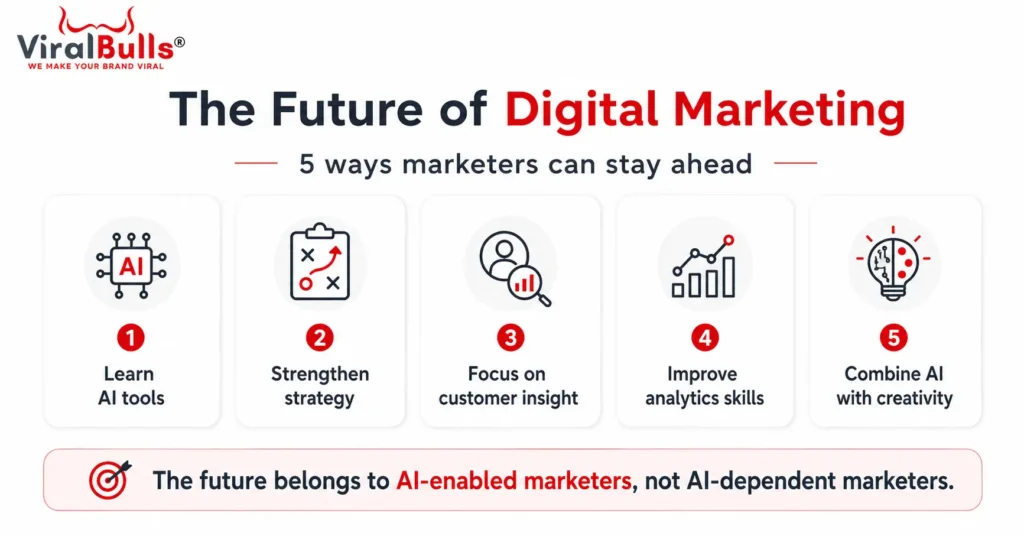
How Marketers Can Stay Valuable
Become AI-Enabled, Not AI-Dependent
Learn to brief AI, provide context, evaluate outputs, build workflows, and document quality controls. Do not outsource your thinking.
Strengthen Customer Research
Study interviews, sales conversations, support tickets, and why customers choose, hesitate, or switch. Proprietary insight is difficult to copy.
Build Measurement Literacy
Understand attribution, conversion tracking, CAC, LTV, contribution margin, lead quality, and funnel leakage. Marketers who connect activity to profit are harder to replace.
Develop Strategic and Creative Judgment
The future of digital marketing will contain more content, not necessarily better content. Learn positioning, storytelling, offers, testing, and conversion.
HubSpot’s 2026 research describes AI as a baseline rather than a differentiator and reports that 61% of marketers believe AI is causing marketing’s biggest disruption in 20 years.
Learn AI Governance
Create standards for approved tools, confidential data, fact-checking, intellectual property, bias review, disclosure, and final human approval.
Measure Outcomes, Not Output
Publishing 100 posts is not a business result. Focus on qualified traffic, pipeline, revenue, retention, acquisition efficiency, brand demand, and customer value.
What Should Be Automated and What Should Stay Human-Led?
| Automate or AI-assist | Keep human-led |
| Report summaries | Interpretation and budget decisions |
| Content outlines and variations | Positioning, evidence, and approval |
| Bid and placement optimization | Commercial goals and guardrails |
| Lead routing and scoring | Sales alignment and exceptions |
| Audience pattern detection | Ethical targeting decisions |
| Personalization at scale | Customer experience strategy |
| Routine email journeys | Offer and lifecycle strategy |
| Experiment idea generation | Test prioritization and causal judgment |
Automate high-volume, reversible, measurable tasks first. Keep humans closely involved when decisions are high-risk, customer-facing, difficult to reverse, legally sensitive, or central to brand identity.
The Future of AI in Marketing
The future of AI in marketing will move from isolated prompts toward connected systems and agents that access approved information, execute workflows, and report results.
Some execution teams may become smaller. Demand will grow for people who design systems, interpret data, direct creativity, manage technology, and connect marketing with revenue. Production-only agencies will face pressure, while strategic and integrated agencies can become more valuable.
The World Economic Forum expects nearly 40% of job skills to change by 2030. It identifies AI and big data among the fastest-growing skills while emphasizing creative thinking, resilience, leadership, curiosity, and other human capabilities.
This is the clearest answer to “Will AI Replace Digital Marketers?” AI literacy and human capability are complementary. Strong professionals will develop both.
Five-Step Action Plan
- Audit tasks: Rank recurring activities by time, cost, risk, and value.
- Select use cases: Start with research organization, drafts, reporting, classification, and workflow assistance.
- Set controls: Define source requirements, privacy limits, brand rules, review roles, and testing standards.
- Train the team: Teach prompting, verification, data literacy, strategic thinking, and responsible use.
- Measure impact: Track time saved, quality, conversion changes, errors, customer response, and financial return.
Frequently Asked Questions
1. Will AI Replace Digital Marketers Completely?
No. It will automate parts of digital marketing, but complete replacement is unlikely because marketing requires strategy, empathy, originality, accountability, and leadership.
2. Can AI Replace Content Marketers?
AI can replace some low-complexity writing tasks and accelerate first drafts. It cannot reliably replace original experience, expert interviews, brand voice, or final factual responsibility.
3. Will AI Take Over Marketing Jobs by 2030?
Some tasks and roles will decline or change, while responsibilities in AI workflow design, governance, data, creative strategy, and customer experience will grow.
4. Which Digital Marketing Jobs Are Safest From AI?
Roles involving strategy, research, creative direction, analytics interpretation, revenue ownership, compliance, leadership, and deep domain expertise are relatively more resilient.
5. What Marketing Tasks Can AI Automate?
AI can assist with keyword clustering, outlines, ad variations, personalization, lead scoring, bid optimization, report summaries, segmentation, and workflow triggers.
6. Is AI-Generated Content Good for SEO?
It can be when it is accurate, useful, original, well-structured, aligned with search intent, and reviewed by knowledgeable people.
7. How Will AI Change Digital Marketing Careers?
Marketers will spend less time on repetitive production and more time on strategy, quality control, experimentation, data interpretation, customer insight, and governance.
8. What Skills Should Future Digital Marketers Learn?
Prioritize AI literacy, analytics, attribution, customer research, positioning, storytelling, conversion optimization, automation, privacy, and experimentation.
9. Is Digital Marketing Still a Good Career After AI?
Yes, for people willing to adapt. Businesses still need acquisition, retention, brand building, demand generation, communication, and growth.
10. How Can a Small Business Use AI Safely?
Start with low-risk use cases, use approved data, review customer-facing outputs, protect confidential information, verify claims, and measure real business results.
Conclusion
So, Will AI Replace Digital Marketers? It will replace selected tasks, compress some roles, and raise expectations across the profession. It will not eliminate the need for people who understand customers, make strategic trade-offs, direct creativity, interpret evidence, protect trust, and accept responsibility for outcomes.
The real competition is not AI vs human marketers. It is AI-enabled marketers vs marketers who continue working as though the technology does not exist.
Use AI to remove manual work, improve analysis, accelerate testing, and personalize customer experiences. Keep human judgment central to positioning, ethics, culture, quality, and final decisions.
The future of marketing is a disciplined partnership: machines provide speed and scale, while people provide meaning, judgment, and direction.
Also Read: How Much Does It Cost to Build a Shopify Website? A Detailed Guide